ACH Direct Deposit | How It Works, Costs & Setup Guide!
Categories: ACH Payments
Categories: ACH Payments
Direct deposit is a payment method where funds are transferred electronically straight into your savings or checking account, instead of being handed to you as a physical paycheck. If you’ve ever woken up on payday to find your money already sitting in your bank account, that’s direct deposit at work — and specifically, it’s an ACH direct deposit, powered by the Automated Clearing House network that moves money between banks behind the scenes.
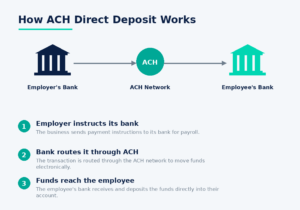
It’s the quiet, reliable engine behind how most of America gets paid — and increasingly, how businesses handle everything from vendor payments to tax refunds. Direct deposit isn’t a niche convenience anymore; it’s the standard, with 93% of American workers now getting paid this way. It gives people faster access to their money with no extra fees to receive it, and beyond payroll, it’s commonly used for bonuses, reimbursements, and other employee payments.
An ACH direct deposit is a type of electronic funds transfer made into a consumer’s checking or savings account — typically from an employer, or a federal or state agency. The most common types include salary payments, tax refunds, and government benefits.
ACH transfers have largely made paper checks obsolete, and for good reason: they’re faster, cheaper, and safer. A direct deposit sent through the ACH network is usually received within 1-2 business days, making it a smart option for small businesses looking to save money while paying employees on time.
How an ACH deposit works, step by step:
ACH stands for the Automated Clearing House, a computer-based electronic network that processes transactions between financial institutions. It’s designed for high-volume, low-value payments and underpins a huge share of everyday financial activity.
Common examples of ACH processing include:
ACH is sometimes called “direct pay” or an “electronic check,” and its usage keeps climbing. In 2019, the ACH network moved 24.7 billion electronic payments, making it one of the safest and most reliable payment systems in the world. That year marked the fifth consecutive year in which the network added more than 1 billion payments, spanning categories like:
Altogether, the total value of ACH payments processed exceeded $55.8 trillion.
Setting up ACH direct deposit requires a few key pieces of information: a savings or checking account, a routing number, and an account number. Without this data shared upfront, a direct deposit simply can’t be initiated — a business needs to know exactly where to send your pay.
In ACH terminology, you’ll often see the terms ODFI (Originating Depository Financial Institution) and RDFI (Receiving Depository Financial Institution). A financial institution can act as an ODFI, an RDFI, or both, depending on the transaction. Regardless of role, these institutions must work with ACH operators or the Federal Reserve to ensure transactions run smoothly, securely, and within agreed-upon timeframes.
One of the biggest draws of ACH is how inexpensive it is compared to alternatives. ACH transactions typically involve a few types of fees:
These costs are dramatically lower than paper checks or wire transfers. According to AFP’s Payments Cost Benchmarking Survey, the median cost to issue an ACH payment is $0.29, compared to $1.57 for a check and $14.42 for a wire transfer.
Setting up ACH direct deposit is far less complicated than most businesses expect. The typical process looks like this:
ACHgenie can help businesses validate ACH files to ensure that the files are compliant to the Nacha standard..Small businesses can partner with a payroll service provider that already has ACH capabilities built in. At minimum, you’ll need to collect:
Rachel, an HR manager at a home healthcare company, put it simply: “When we first looked into direct deposit, I thought it would be this huge project. But our payroll provider handled most of the technical setup. The biggest job was just collecting everyone’s banking information and consent forms. Within two weeks, we were up and running.”
Enrolling in direct deposit as a recipient is even simpler:
Many banks now offer “direct deposit switch kits” that make it easy to update your payment details across multiple payors whenever you change banks.
A NACHA study found that businesses using ACH for payroll save an average of $3.15 per payment compared to paper checks, once all associated costs are factored in.
A Federal Reserve study found that 99% of consumers who use direct deposit report being satisfied with it, citing convenience and reliability as the top benefits.
What is an ACH debit?
An ACH debit is the reverse of a direct deposit — instead of funds being pushed into your account, an authorized party pulls funds out, such as for a recurring bill payment or loan installment.
Are all direct deposits ACH?
The vast majority are. Direct deposit is simply the outcome (money lands in your account); ACH is the network that most commonly makes it happen.
How long do ACH direct deposits take?
Most ACH direct deposits are received within 1-2 business days of being initiated.
What’s the difference between ACH and a bank transfer?
“Bank transfer” is a broad term that can include wire transfers, ACH transfers, and other methods. ACH specifically refers to transactions processed through the Automated Clearing House network, which tend to be slower but far cheaper than wire transfers.
Can ACH payments be reversed?
Yes, under certain circumstances, such as an error, unauthorized transaction, or insufficient funds — though there are strict time limits and rules governing reversals.
How does ACH differ from wire transfers?
Wire transfers are typically faster (often same-day) but significantly more expensive, while ACH transfers take 1-2 business days and cost a fraction of the price.
Why are direct deposits being delayed?
Delays can stem from bank processing schedules, holidays, weekends, incorrect account information, or additional fraud-review holds.
What happens if a direct deposit fails?
A failed deposit is typically returned to the originator, who will need to correct the account information and reinitiate the payment.
How can I resolve a direct deposit error?
Contact your employer or payor’s payroll/HR department first to confirm your banking details are correct, then follow up with your bank if the issue persists.
ACH direct deposit has become the backbone of how money moves in the U.S. — cheaper, safer, and faster than paper checks, and increasingly essential for businesses that want to stay competitive while keeping payroll costs down. Whether you’re an employer setting up payroll or an employee switching banks, the process is simpler than it looks, and the benefits are well worth the short setup time.
For businesses that want to bring ACH origination in-house without the usual technical overhead, solutions like ACHgenie offer a straightforward way to create, test, and transmit direct deposit files directly to your bank — securely and on your own schedule.