How to Track Your Transaction ID?
Categories: ACH Payments
Categories: ACH Payments
Managing digital payments in 2026 requires more than just checking your balance. Whether you are a business owner dealing with a missing vendor payment or a consumer trying to track my transaction id for a recent purchase, understanding the digital breadcrumbs of the financial network is essential.
Transaction id tracking has evolved. With the latest 2026 Nacha Operating Rules and the rise of real-time payment rails, the “trace number” is your most powerful tool for financial accountability. This guide explores how to track bank transaction id, manage merchant transaction id tracking, and use a transaction id tracker to ensure your money lands exactly where it should.
A transaction id number tracking code—often referred to in the banking world as an ACH Trace Number—is a unique 15-digit digital fingerprint assigned to every financial movement. In the current 2026 regulatory landscape, these IDs are the backbone of fraud detection processes mandated by Nacha for all Originating Depository Financial Institutions (ODFIs).
While people often ask, “is a transaction id a tracking number?” the answer depends on the context. In logistics, a tracking number follows a physical box. In finance, a transaction id tracking number follows the digital “packet” of money as it moves from Bank A to Bank B. It allows you to track money with transaction id across different banking internal systems.
Every ACH trace number follows a strict format to ensure interoperability:
Finding the right code is the first step to transaction id tracking online. Depending on the platform, the ID might be labeled differently.
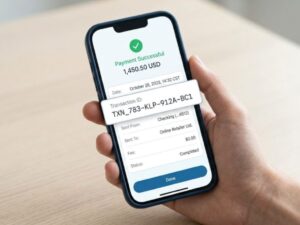
For traditional banking, look for SEPA transaction id tracking or ACH trace numbers in your “Transaction Details.” Under 2026 rules, wage payments must be labeled as PAYROLL, and e-commerce debits as PURCHASE. If you are using specific institutions, like sbi transaction id tracking or andhra bank transaction id tracking, the ID is usually found in the downloadable PDF statement next to the “Reference Number” field.
For mobile users, PhonePe transaction id tracking and track Google Pay transaction id are common needs.
When you buy something online, you get a merchant transaction id tracking code. This is vital for refund transaction id tracking if you return the item. If you need to track order with transaction id, check your confirmation email for a “Transaction Reference” or “Order ID.”
Quick Tool Tip: If you are a business managing high volumes of these files, ACHgenie provides a Nacha File Editor that allows you to view and perform raw line editing on these IDs before they are even transmitted, preventing errors before they happen.
| Payment Type | Primary Tracking ID | Where to Find It | Typical Resolution Time |
| ACH/Direct Deposit | 15-Digit Trace Number | Bank Statement/ACHGenie | 1-3 Business Days |
| Credit Card | Auth Code / Trans ID | Credit card transaction id tracking via App | Instant to 48 Hours |
| Wire/SEPA | UETR / Reference ID | SEPA transaction id tracking portal | Same Day (Global) |
| Crypto | TXID / Hash | Track crypto transaction id on Explorer | 10-60 Minutes |
| Digital Wallets | Wallet Ref ID | Track google transaction id in App | Instant |
If you are wondering how to track transaction id online, follow this high-intent workflow to resolve missing funds.
Access your financial portal. For business users, tools like ACHgenie allow you to see if a status is Created, Submitted, or Settled. This is the first step in bank transaction id tracking.
If the payment is pending for more than three business days, the trace number is your primary tool. It allows the Receiving Depository Financial Institution (RDFI) to “pull” the transaction through the network. This is essentially how you track payment by transaction id.
If you are moving assets via blockchain, you must track binance transaction id or track crypto transaction id using a block explorer. Simply paste the TXID into the search bar of the relevant network (e.g., Etherscan or Blockchain.com) to see the confirmation count.
The 2026 standards require banks to monitor for “False Pretenses.” If your transaction id tracking shows “Flagged,” it may be held by an AI-driven fraud filter. You will need to provide the transaction reference id tracking number to your bank’s fraud department to clear it.
Imagine a furniture wholesaler, “Global Decor,” sends a $50,000 ACH transfer to a supplier. Five days pass, and the supplier claims they haven’t received it.

A common point of confusion is whether you can track package by transaction id or track package with transaction id.
Technically, a Transaction ID is a financial record, not a logistics record. However, many modern retailers link the two. If you have a transaction order id tracking number, you can often enter it into the “Track Order” page of the merchant’s website. If that fails, contact support and ask them to track package using transaction id in their internal ERP system to find the linked FedEx or UPS number.
To track a transaction id, you must first identify the platform used (Bank, PayPal, Crypto). Once you have the ID, visit the “Activity” or “History” section of that platform. For bank transfers, you may need to call the bank and provide the 15-digit trace number for manual track bank transaction id services.
Log in to your banking app and navigate to “Search Transactions.” Enter the ID in the search bar. If it doesn’t appear, use an external transaction id tracker or contact the support team of the payment processor (like skrill transaction id tracking or track binance transaction id support).
Yes. A transaction id tracking search reveals the “Originating Routing Number.” This tells you exactly which bank and branch initiated the transfer, helping you verify the source of the funds.
Check your digital receipt or the “Transaction Details” in your banking app. It is often listed as “Ref ID,” “Trace #,” or “Trans ID.” This is the key for track order transaction id queries.
For bank transfers, there is no universal public website. You must enter it into your bank’s internal portal or a tool like ACHgenie if you are the originator. For crypto, enter it into a blockchain explorer to track transaction id online.
At ACHgenie, we’ve stayed ahead of the 2026 NACHA Operating Rules to ensure your business remains compliant and efficient. Our platform is more than just a tracking tool; it’s a full-scale financial integrity suite.
Use this list to ensure your transaction id tracking process meets the latest financial standards.
Disclaimer: This article is for informational purposes only and does not constitute legal, financial, or compliance advice. Always consult with a certified NACHA professional or legal counsel regarding 2026 Operating Rules and financial regulations.
Ready to streamline your payments? Learn more about ACHgenie’s validation tools and ensure your transaction id tracking is flawless every time. For deeper insights into global banking, check out the Federal Reserve’s guide on payment systems or visit Nacha’s official 2026 rulebook to stay ahead of the curve. You can also explore Consumer Financial Protection Bureau resources to understand your rights regarding how to track a payment using transaction id.