Account Number vs. Routing Number vs. Electronic Account Number
Categories: Financial Institution Software
Categories: Financial Institution Software
Meta Description: Learn the difference between an account number, routing number, and electronic account number, plus where to find each one.
A bank account number identifies a specific account at a financial institution, a routing number identifies the institution itself, and an electronic account number is a temporary, masked identifier used to protect the real account number during digital transactions. Together, these identifiers determine whether a payment — a direct deposit, an ACH transfer, or an online purchase — lands in the right place. Confusing them is one of the most common reasons electronic payments are delayed or rejected.
A routing number is a nine-digit code that identifies the specific bank or credit union holding an account. It functions like a mailing address for the institution: it tells the payment network which bank to route funds to, but it says nothing about whose account within that bank should receive the money. Routing numbers are public information and are typically printed as the first group of numbers along the bottom of a check.
Routing numbers are sometimes called transit numbers, ABA numbers, or, in the context of electronic transfers, ACH routing numbers. They can vary based on where an account was opened, meaning the same bank may issue different routing numbers for different regions.
An account number is a unique string of digits — typically 8 to 12 characters — that identifies one specific account within a financial institution. If the routing number is the bank’s address, the account number is the equivalent of an apartment number: it points to exactly where funds should be deposited or withdrawn.
Account numbers appear as the second group of digits on a printed check, immediately following the routing number. Because the surrounding placement can occasionally be reversed with the check number, the safest way to identify it is by length — the account number is almost always the longer of the two remaining strings. Outside of a paper check, the account number can be found by logging into online or mobile banking, checking a monthly statement, or calling the institution directly.
Credit unions frequently use the term “member number” instead of “account number,” which causes confusion for people moving between bank and credit union terminology. In many cases the member number and account number are the same.
Some institutions attach an additional account suffix — a short code appended to the member number that distinguishes between a checking account, savings account, or loan held under the same membership. When in doubt, the safest source of truth is the checking account suffix or account number listed on a statement or within online banking, not an assumption based on another institution’s format.
An electronic account number is a temporary, virtual identifier that stands in for a real bank account number during digital transactions. Rather than exposing the permanent account number to a merchant, app, or payment processor, the system generates a masked number for that specific transaction or session. If it is intercepted, it cannot be reused to access the underlying account.
This distinction matters increasingly as digital payment volume grows and payment fraud remains a persistent concern for both consumers and financial institutions, which is part of why masking permanent account details during electronic exchanges has become standard practice.
Here is the link to the Payments Fraud Survey Report.
| Attribute | Account Number | Electronic Account Number |
| Permanence | Fixed for the life of the account | Temporary, often single-use |
| Primary use | Direct deposit, ACH payments, wire transfers | Online shopping, mobile banking, one-time digital transactions |
| Exposure risk | Higher if shared repeatedly | Lower — masks the real number |
For recurring transactions such as payroll direct deposit or ACH bill payments, the permanent account number is still required — electronic account numbers are not typically accepted for these use cases.
A standard check displays three groups of numbers along the bottom edge, known collectively as the MICR line: the routing number first, the account number second, and the check number last. The check number is the shortest of the three and carries no banking significance beyond helping the account holder track which check was written; it’s also the source of common questions like “what is the starting check number” on a new account, since newly issued check orders typically begin at a set sequence (often 1000 or 1001) rather than continuing from a previous account.
Because placement conventions differ slightly by bank, the MICR number and account number are best confirmed against a bank statement or online banking portal rather than assumed from position alone.
Financial institutions and payment processors depend on accurate routing and account number data to move money correctly. A single transposed digit in either field can cause a transaction to bounce, delaying payroll, vendor payments, or bill pay. Nacha publishes annual ACH Network volume figures showing tens of billions of payments moving through the network each year, worth tens of trillions of dollars, a scale at which even a small error rate translates into a significant number of rejected files.
This is where automated validation becomes valuable. ACHgenie’s bank account and routing number verification tools are built to catch formatting and check-digit errors before a NACHA file is submitted, reducing rejected transactions caused by mistyped or mismatched account data.
Here is a screenshot of ACHgenie reporting successful lookup of an ABA Routing Number:
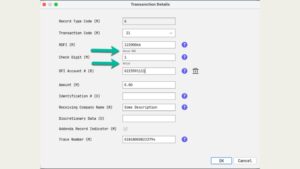
For institutions processing high volumes of direct deposits, that verification step also supports broader fraud-prevention efforts by flagging inconsistencies — such as an account number format that doesn’t match a known routing number range — before funds move.
No. The ACH routing number identifies the financial institution, while the account number identifies the specific account within that institution. Both are required to complete an electronic transaction, but they serve different functions.
At most credit unions, yes — the member number often doubles as the base account identifier, sometimes combined with an account suffix to distinguish between checking, savings, or loan sub-accounts. It’s best to confirm the exact figure through online banking or a statement.
An account number is permanent and tied directly to the underlying bank account. A virtual or electronic account number is a temporary substitute used to shield the real number during online or mobile transactions.
Account numbers are listed in online banking account summaries, mobile banking apps under account details, and on monthly statements. They can also be obtained by phone or in person after identity verification.
An account number alone generally cannot be used to withdraw funds without the accompanying routing number and, in most cases, additional authentication. However, exposure still increases the risk of unauthorized ACH debits or check fraud, which is why institutions recommend treating it as sensitive information.