How Long Does an ACH Transfer Take?
Categories: ACH Payments
Categories: ACH Payments
Standard ACH transfers take 1–3 business days to complete, while Same-Day ACH can settle within hours when submitted before a bank’s cutoff time. The exact timeline depends on the type of ACH transaction, when it is initiated, and how quickly the originating and receiving banks process the request. For finance teams managing payroll, vendor payments, or recurring billing, understanding this timeline is essential to avoiding cash flow surprises — and platforms like ACHgenie are built specifically to keep these transfers fast, accurate, and predictable.
The Automated Clearing House (ACH) network is a batch-based electronic payment system that moves funds between U.S. bank accounts. Governed by Nacha, the ACH network processes billions of transactions each year, covering everything from direct deposit and payroll to vendor payments and recurring subscriptions.
Unlike wire transfers, which move funds individually and in real time, ACH transactions are grouped into batches and released at scheduled intervals throughout the business day. This batch structure is what keeps ACH payments inexpensive and reliable, though it also introduces the processing windows that create the 1–3 day timeline.
Every ACH transfer moves through a chain of financial institutions. The originating bank (ODFI) submits the payment to an ACH operator — either the Federal Reserve or The Clearing House — which routes it to the receiving bank (RDFI) for final credit to the recipient’s account. Businesses using ACHgenie benefit from automated routing and batch scheduling that removes much of the manual coordination this process traditionally requires.
Delays can surface at nearly any stage of this chain, which is why timelines vary even for transactions submitted on the same day.
ACH transactions fall into two categories, and each affects processing speed differently:
Both transaction types generally follow the same 1–3 business day settlement window, but the additional verification applied to debits means processing priority can differ by bank. ACHgenie helps businesses manage both transaction types from a single dashboard, applying automated authorization checks that reduce the risk of delays on the debit side.
| Transfer Type | Timeline | Best For |
| Standard ACH | 1–3 business days | Routine payments, cost efficiency |
| Same-Day ACH | Same business day (cutoff applies) | Urgent or time-sensitive payments |
| Next-Day ACH | Next business day | Payroll and predictable recurring payments |
Same-Day ACH requires meeting an afternoon cutoff and typically carries a small processing fee, while standard ACH remains the most cost-effective option for routine transactions.
Several factors can push a transfer past the expected window:
Even small data-entry errors can disrupt routing between ACH operators and receiving institutions. Verifying account and routing details before submission — a step built into ACHgenie’s transfer workflow — is one of the simplest ways to prevent avoidable delays.
Wire transfers process individually in real time rather than in batches, making them the faster option — often settling within hours for domestic transfers. ACH, by contrast, takes 1–3 business days for standard processing.
Speed comes at a cost, however:
Wire transfers suit high-value, time-critical payments such as real estate closings. ACH remains the better fit for payroll, recurring vendor payments, and any transaction where cost efficiency outweighs speed.
Platforms like ACHgenie combine automated error checks, multiple daily submission windows, and built-in approval workflows to reduce the manual back-and-forth that typically slows ACH processing.
The ACH network operates under rules set by Nacha, covering transaction formatting, authorization requirements, and settlement timelines. Businesses initiating ACH debits must obtain proper authorization in advance, and detailed record-keeping is required for audit and dispute purposes. Financial institutions are also required to monitor for unusual activity under federal risk-management guidance, which can occasionally add review time to legitimate transactions. Non-compliance can result in fines or removal from the network, making reliable, compliant processing tools essential for any business relying on ACH.
ACH is primarily a domestic U.S. payment rail. Cross-border ACH options exist through correspondent banking relationships but generally take longer than domestic transfers and may involve currency conversion. For most international payments, wire transfers remain the more practical choice due to broader global reach and faster settlement. Businesses with significant cross-border needs often pair domestic ACH — managed through ACHgenie — with wire transfers for international transactions, balancing cost and speed across payment types.
ACHgenie is built to validate ACH files to ensure compliance with Nacha format and guidelines. Validating ACH files using ACHgenie ensures smooth processing and less rejections. Delayed or rejected ACH files impact financial transactions.
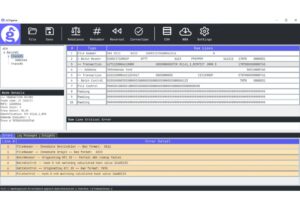
ACHgenie is especially useful when a manual edit needs to be made to a file. ACHgenie guides the user to keep the ACH file compliant to the Nacha standard. Then, ACHgenie allows the user to balance of the file to ensure all the credits/debits are updated, all the hash values are updated.
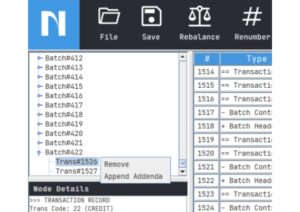
ACHgenie also allows removing a transaction from an ACH file. Then, ACHgenie allows balancing the ACH file to ensure that the balances and hash values are updated.
Can ACH transfers be reversed?
ACH transfers can be reversed in limited cases, such as fraud, duplicate payments, or incorrect amounts. Timeframes and procedures vary depending on the error type and whether the account is consumer or business.
Does ACHgenie support Same-Day ACH?
Yes. Same-Day ACH is available for expedited processing when transactions are submitted before the applicable cutoff time.
Is ACH safe for large transfers?
ACH is widely used for payroll and vendor payments, with Nacha oversight and multi-layered fraud screening, including encryption and transaction monitoring.
What happens if an ACH transfer is rejected?
A rejected transfer generates a return code identifying the issue, such as insufficient funds or incorrect account details. Correcting the error and resubmitting typically adds 2–3 business days to the original timeline.
What’s the difference between ACH and EFT?
ACH is one type of electronic funds transfer (EFT) operating through the Automated Clearing House network. EFT is the broader category that also includes wire transfers, card payments, and other electronic payment methods.
Do all U.S. banks accept ACH payments?
Yes. All U.S. banks and credit unions participate in the ACH network, either directly or through correspondent banking relationships.