How to Find Your Routing Number & Account Number?
Categories: ACH Validation
Categories: ACH Validation
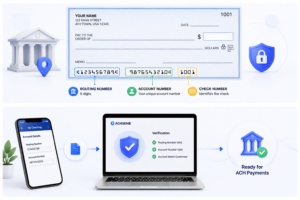
Your routing number and account number are the two codes that tell banks exactly where your money should go. The routing number is the 9-digit code identifying your bank, and it’s the first group of numbers on the bottom left of a check; the account number is the longer, unique code identifying your specific account, and it sits right next to it. Together, these numbers power everything from direct deposit to bill pay to ACH transfers — and with ACHgenie, you can verify and use them instantly to set up fast, error-free ACH payments without digging through paperwork.
A routing number (also called a transit number) identifies the specific financial institution where your account is held. Banks and payment processors use it to know exactly where to send or pull funds during a transaction. Employers need it to set up direct deposit, and payment platforms need it to link your bank account. Routing numbers are public information and can vary by the state or region where you opened your account, and in many banks, you’ll even see a different routing number for wire transfers than for ACH transactions or check orders.
You can confirm any bank’s routing number is valid through the Federal Reserve’s official E-Payments Routing Directory, which is the authoritative source financial institutions use to verify routing information before processing a transaction.
This is exactly the kind of verification step ACHgenie automates. Instead of manually cross-checking routing numbers before every payment, ACHgenie validates account and routing number combinations in real time, reducing failed or misdirected ACH transactions before they happen.
Look at the bottom-left corner of a personal check — the first set of numbers, surrounded by a special character symbol (not part of the number itself), is your routing number. It’s always 9 digits long. If you don’t have a physical check handy, most banks also display your routing number inside their mobile app or online banking portal, typically under “Account Info” or “Account Details.”
The second group of numbers, printed just after the routing number, is your account number. Occasionally, its position is swapped with the check number, so the simplest way to identify it is by length — your account number is almost always the longer of the two remaining numbers. This number is private and unique to you; it won’t appear anywhere public, only on your personal checks, bank statements, or inside your online banking account.
Your account number is what your bank uses to route deposits and withdrawals to the correct place. Any time you set up direct deposit, an electronic payment app, or recurring ACH billing, you’ll be asked for this number specifically — which is also the exact input ACHgenie needs to initiate a secure transfer on your behalf.
The check number is typically the last — and shortest — set of digits on your check. It carries no banking significance beyond helping you and your bank track which check was written and when, useful for reconciling your check register or spotting a missing check.
Here are different ways to find your bank routing and account number:
Once you have both numbers, ACHgenie lets you securely save and reuse them for recurring ACH payments, payroll, or vendor disbursements — so you’re not re-entering (or re-hunting for) them every billing cycle.
Some banks issue different routing numbers depending on the transaction type, which trips up a surprising number of customers.
Because ACH routing numbers can differ from wire or check-order numbers, always confirm which one your bank has on file before setting up a transfer. This is precisely where mismatches cause failed payments — and precisely where ACHgenie’s built-in routing number verification saves users from costly, delayed transactions.
A single transposed digit in either your routing or account number can send a payment to the wrong account, delay payroll, or trigger a bounced ACH transaction. That’s the core problem ACHgenie was built to solve: automated verification, encrypted storage, and one-click reuse of your banking details for every future transfer — so you enter your numbers correctly once, and never worry about a typo derailing a payment again.
Is my routing number the same for wires, ACH, and checks?
Not always. Some banks issue separate routing numbers for wire transfers, ACH transactions, and check orders. Always check your specific bank’s documentation or online banking portal to confirm.
Can I find my account and routing numbers without logging into a computer?
Yes. Most banks offer this information through their mobile app, by phone, or in person at a branch, in addition to online banking.
Is it safe to share my routing and account number?
Sharing your routing and account number for legitimate purposes like direct deposit or ACH payments is generally safe, since these numbers alone can’t be used to withdraw funds without additional authorization. Still, only share them with trusted, verified institutions or platforms that encrypt and protect your banking data.
What happens if I use the wrong routing number for an ACH payment?
The transaction is typically rejected or delayed by the receiving bank, and in rare cases, funds can be misdirected. Using a verification tool such as ACHgenie before submitting a transfer helps prevent this.
Where can I double-check that a routing number is valid?
The Federal Reserve’s E-Payments Routing Directory is the authoritative public source for verifying any U.S. bank routing number.